Perimenopause and Parenting
Why Mid-Life Can Affect Patience, Mental Health, and How We Show Up
If you are reading this let’s start by saying you are not crazy or broken. Your nervous system may just be stuck in overdrive. There is a quiet epidemic among women that no one is talking about or prepares us for, and I am here to bring it up. That is the perimenopause and menopause journey. The mood shifts. The overwhelm. The exhaustion that doesn’t make sense. The feeling you are not yourself anymore. You are not imagining it. You are not alone. There comes a season in motherhood when our bodies and mind have a transition. We may ask ourselves:
Why does this feel harder than it used to?
Why am I more overwhelmed, more reactive, more anxious, even though I love my children deeply?
For many mothers, the answer isn’t a lack of skill, love, or effort. It’s perimenopause. And no one prepared us for how much it could affect not just our bodies—but our brains, nervous systems, and parenting.
What Is Perimenopause and Why It Matters for Mothers
Perimenopause is the hormonal transition leading up to menopause. It often begins in the late 30s or early 40s—right when many women are raising children, carrying heavy mental loads, and managing nonstop demands.
While hot flashes get the attention, many women first experience emotional and neurological symptoms, including:
increased anxiety or panic
brain fog and difficulty focusing
emotional sensitivity
irritability or a shorter fuse
overwhelm and overstimulation
disrupted or non-restorative sleep
feeling “unlike yourself”
Without understanding what’s happening, many mothers internalize this shift as personal failure—when it’s actually biological.
The Brain Science Behind Perimenopause and Parenting
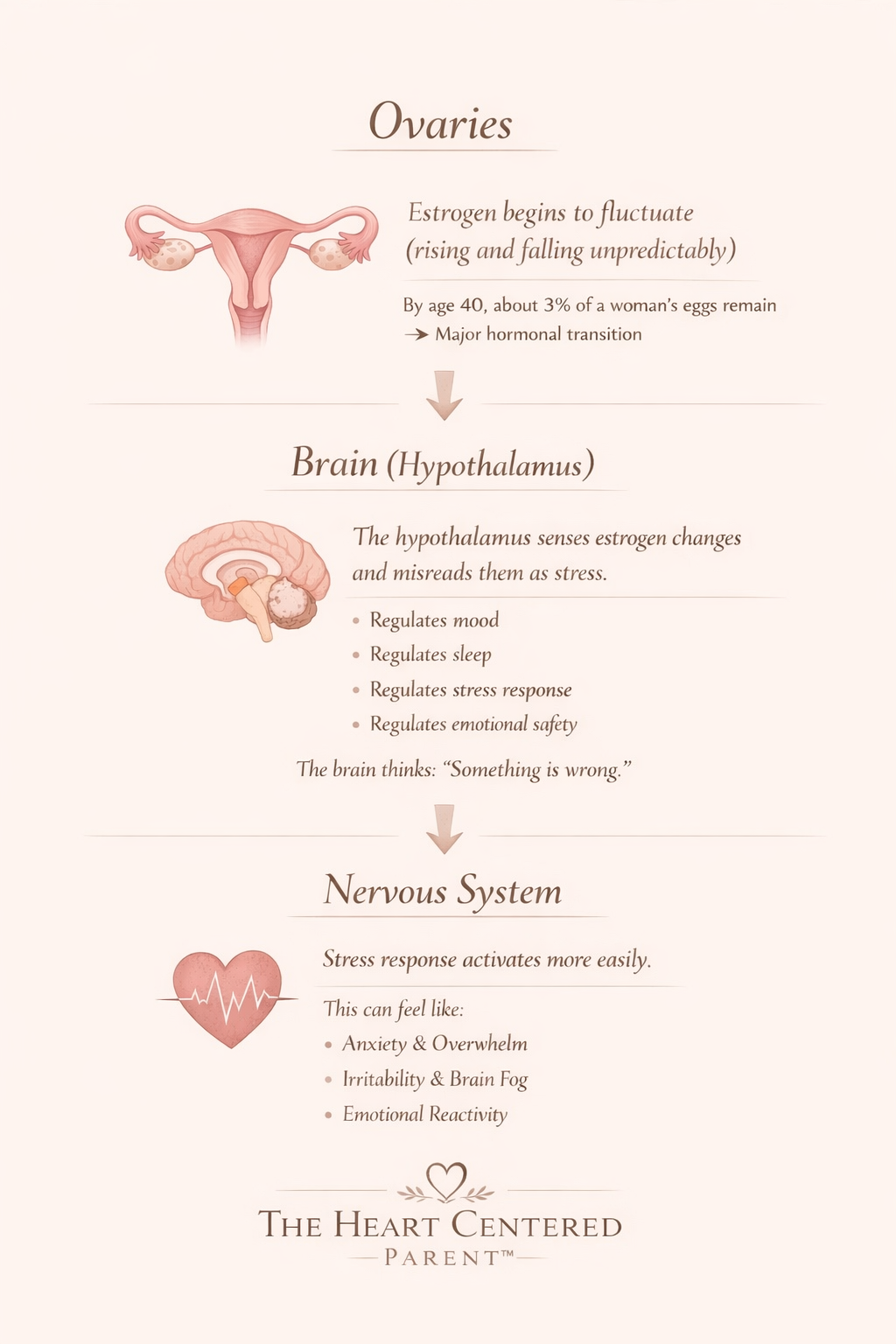
By the time we hit 40, our ovaries send a signal to the brain that we have fewer eggs left, triggering shifts in estrogen, progesterone, and the hormones that regulate our cycle. Estrogen doesn’t only affect reproduction. It plays a critical role in the brain and nervous system.
Did you know Estrogen supports emotional regulation, stress tolerance, dopamine (focus and motivation), nervous system calm, mood stability and sleep quality? During perimenopause, estrogen fluctuates unpredictably. These fluctuations impact the brain’s stress center, making the nervous system more likely to enter fight-or-flight. Again, by the age of 40, your ovaries signal the brain: supply is lower, hormones are shifting—nothing is wrong with you. However, patience runs out faster, noise feels louder, reactions come quicker, and emotional recovery takes longer. So, when children push limits or life feels chaotic, the nervous system often reacts before logic can step in. Yelling is rarely about anger. It is often the nervous system trying to release overload. In perimenopause the brain becomes more sensitive to stress and less buffered by estrogen. What looks like snapping, yelling, shutting down, feeling out of character is often the body saying I need support, safety, a different rhythm. This isn’t a parenting problem. It’s a regulation problem.
Mental Health, Chronic Stress, and Depletion
Perimenopause may often overlap with years of chronic stress, emotional labor, under-resting, under-fueling. When stressed, your cortisol levels increase which suppresses estrogen and progesterone, creating a cycle of: stress- hormonal depletion -nervous system dysregulation. This is why nourishment, rest, and slower rhythms aren’t luxuries in midlife. They are foundational to mental health and parenting well.
This season isn’t about pushing harder. It’s about alignment. What I have found that helps the most is nervous system regulation, fewer commitments, more rest without guilt, stable blood sugar and healthy nourishment, slowing down expectations, and responding instead of reacting. As mothers regulate, something shifts.
Patience returns not because life is easier, but because the body feels safer. Connection deepens. Homes soften. Children feel this immediately.
Support for Mothers
This is where I come in as a parent coach to support mothers. We don’t need fixing. More parents need language, understanding, and support during this transition. I help support parents who are stuck in overwhelm and unsure why, long to feel calmer and more present, and who are ready to break generational cycles. This work isn’t about doing more. It’s about returning to regulation, safety, and connection. A regulated mother creates emotional safety. A mother who listens to her body models self-respect. I hope to bring more awareness and understanding to mothers regarding their nervous systems, so they stop blaming themselves and can start parenting with compassion and confidence.
If parenting feels harder right now, you’re not alone.You may be transitioning. With awareness, support, and compassion, parenting doesn’t have to lead to burnout or disconnection. It can become a season of healing, wisdom, and wholeness.
Feeling this shift and want support? You don’t have to navigate it alone. I offer coaching for parents who feel overwhelmed, overstimulated, or disconnected from their capacity, and want to rebuild calm, regulation, and alignment at home and within themselves.
👉 Book a session: THE HEART CENTERED PARENT
📩 Questions? Email me at: tamara@theheartcententeredparent.com
Support is allowed. Your healing becomes your child’s inheritance.
-The Heart Centered Parent